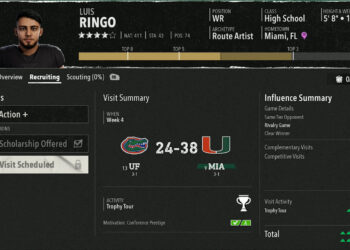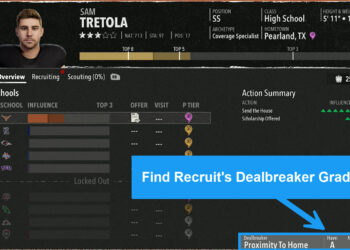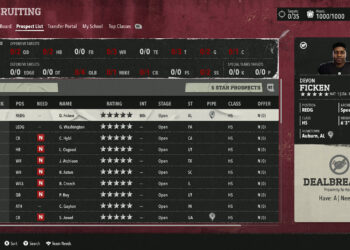
Our goal in this week’s experiment is to find out how much influence different pipeline levels give when recruiting.
As a quick refresher, every school gets pipeline ratings for various geographic zones where they’ve had success (or a lack of success) recruiting in the past. These pipeline ratings range from 0 to 5 with 5 being the highest rated pipeline.
There is almost nothing you can do to change the strength of your pipelines in College Football 25 outside of a couple upgrades inside of the Program Builder coach archetype.
You can view pipelines for every team in CFB 25 here.
Our basic thesis was that we think pipelines matter and the stronger a team’s pipeline tier is, the more recruiting influence they’d get each week.
Turns out, we were incredibly wrong. When it came to influence gained each week, as far as we can tell, there was no impact at all in our testing.
Note: We only tested this on normal “influence” actions like send the house, friends and family, DM, and social media. We have not yet tested this on hard sell or soft sell.
The Usual Caveats
I stress this in every single post but it is important to remember that we are working with limited information and can’t run a truly flawless experiment.
Working within the constraints of the game, we do our absolute best to isolate and test one variable at a time and therefore feel that our results provide actionable insights.
Methodology
Our approach to this study was fairly simple. User control two teams with different pipeline strengths, focus on a specific recruit and get their influence bars as close as possible. Then do the same recruiting action on both teams and see if the team with the stronger pipeline had their lead grow.
We made sure that in all of our tests, both teams had similar coach recruiting skill trees so that one didn’t offer an advantage over the other.
Experiment #1
Our first case was pretty straight forward. We user controlled Texas Tech (Level 4 Pipeline) and Texas (Level 5 Pipeline).
We then got their recruiting interest bars as close as possible to one another and used that as our baseline.
At that point we spent 50 hours on “Send The House” on both Texas Tech and Texas.
Our thinking here was that if Texas’ level 5 pipeline offered more influence than Texas Tech’s level 4 pipeline, it was only a matter of time before Texas overtook Texas Tech.
Please note that in this experiment, UTSA started in 1st place and was not user controlled.
Below you can find screenshots of each week and how the recruiting influence bar unfolded.


(Missing week 6 image for this test but nothing changed)

This recruit ended up committing to Level 4 pipeline Texas Tech over Level 5 pipeline Texas. At no point did Texas ever gain any influence on Texas Tech even though they had a higher tier pipeline.
We also did this same test with the 25 hour “Friends and Family” and the same result happened, it just took a few weeks longer for the recruit to commit.
Experiment #2
The results from our first experiment were shocking and not at all what I was expecting. My first thought was that maybe a tier 4 pipeline and a tier 5 pipeline are high enough where there really isn’t a difference.
So the next logical test was to go back to our initial save point, and take over UTSA who was originally in first place on this recruit but with a level 3 pipeline. Surely, a level 5 or level 4 pipeline would have greater influence than a level 3 pipeline.
We kept everything the same but also added the 50 hour Send the House pitch from UTSA.
Here are what those results looked like.


Again, you can see that the entire time UTSA maintained their influence lead on both Texas Tech and Texas even though they only have a level 3 pipeline on this recruit.
Also, Texas never jumped into second place over Texas Tech even though they had a higher pipeline.
At this point we can be pretty confident that pipelines don’t impact week to week influence. Just to be sure though we’ll do one more test with completely different teams on a completely different recruit.
Experiment #3
For this last test we user control two teams: Georgia and South Alabama. We will be recruiting a kicker who is within a level 5 pipeline for Georgia and has no pipeline whatsoever for South Alabama.
We’ll get them as close as possible to sharing the same influence level at baseline and then “Send the House” with 50 hours on both of them.
Here are the results.


Again over these 8 weeks, we can see that Georgia never made any progress on South Alabama (given consistency on recruiting actions and coach skills).
This recruit ended up committing to South Alabama.
We did this same test again while using the 25 hour “Friends and Family” recruiting pitch instead of the 50 hour “Send The House.”
In the end we got the exact same result with a commitment to South Alabama, it just took a few weeks longer to get there.
What This Means And Doesn’t Mean
It is important to be clear about what this result means and what it doesn’t mean.
Our testing shows that on a week to week recruiting basis, having a stronger pipeline than whatever team you are recruiting against has no noticeable impact.
You won’t be able to gain on a school simply due to a stronger pipeline. Similarly, a school won’t be able to gain on you due to a stronger pipeline.
One point I want to stress, however, is that this study doesn’t mean pipelines are useless. They could have impact in any number of different ways that aren’t week to week influence.
For example, one thing that seems obvious just from an eyeball test (although no extensive study has been done on this yet) is that you are much more likely to have a higher starting interest from a recruit from a strong pipeline than you are from one in a weak or nonexistent pipeline.
That early advantage can be very meaningful especially when it comes to 4 and 5 star recruits.
It is also possible that pipeline strength could have an impact on hard/soft sells, or in some other way. As we do more testing, we’ll share the results we find!
More useful College Football 25 resources: